The upshot
Leeds Bradford Airport (LBA) wanted to leverage AI and data to support their ambitious growth plans—strengthening their position as the region's leading airport whilst controlling operating costs as they prepared to handle increased passenger volumes. To do this, LBA partnered with Datasparq for a two-day strategy workshop that brought business and technical stakeholders together in the same room to develop an AI strategy for airport operations.
The result was a detailed roadmap identifying £3.5 million in net benefits over five years across two priority areas: an AI-powered staff allocation optimiser for customer operations, and a real-time passenger flow dashboard for security. Most importantly, LBA received specific, executable recommendations they could action immediately—complete with technical feasibility assessments, implementation steps and quantified ROI calculations.
Key benefits:


The opportunity
Leeds Bradford Airport is undergoing operational transformation, extending their capabilities whilst controlling operating costs as they prepare to handle increased passenger volumes. With ambitions to become the leading airport in Yorkshire, LBA identified two critical areas where AI and data could make the biggest difference: customer operations and security.
Customer operations encompasses everything involved in supporting passengers through their airport journey—from assisting passengers with reduced mobility to transporting passengers to aircraft and meet & greet parking services. Security, whilst more straightforward, presents the universal airport challenge: how to make the security process more efficient for both passengers and operations.
LBA's challenge was identifying which specific opportunities would deliver the greatest value and how to execute them practically. Traditional consulting approaches often deliver broad recommendations that require months of additional work to become actionable, but LBA needed a roadmap they could implement immediately.
The challenges we faced:
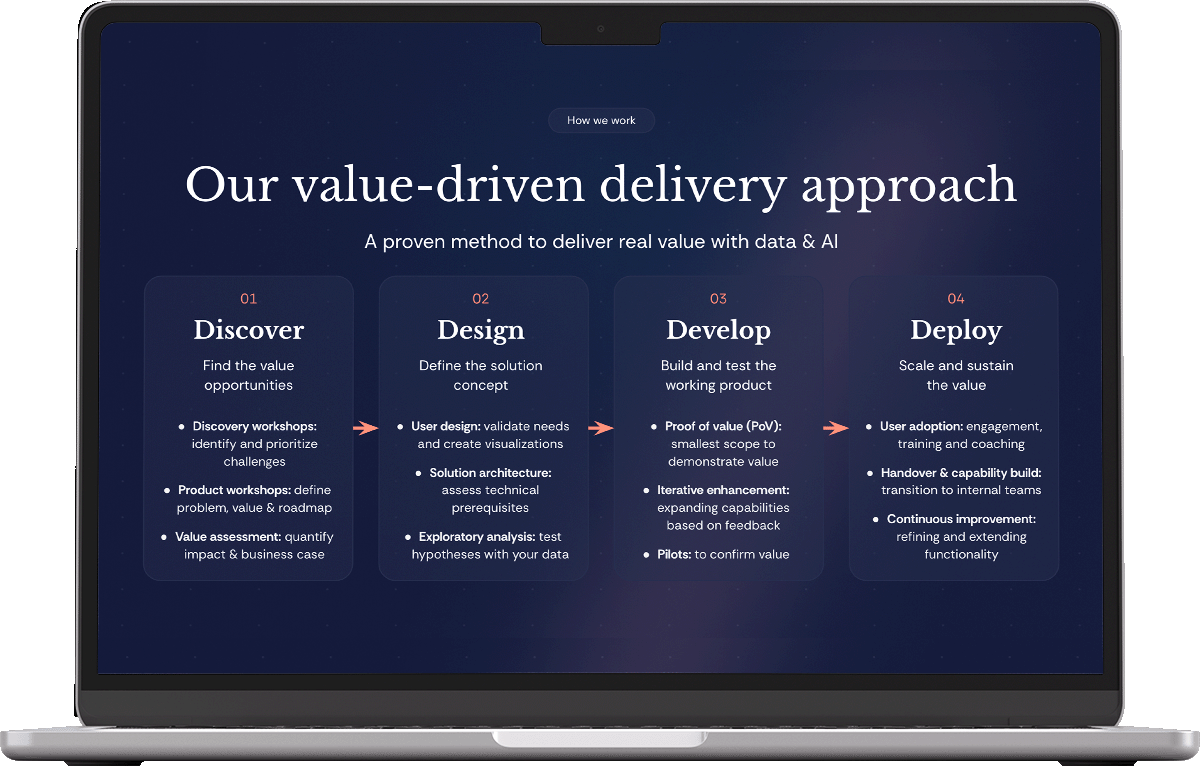
We developed a rapid workshop methodology that brings business stakeholders and technical experts together from day one.
We spent two days at Leeds Bradford Airport—one with the customer operations team, one with the security team.
Using service blueprint methodology from design thinking, we mapped detailed passenger journeys for two strategically chosen personas: passengers with reduced mobility and families.
We identified front-stage interactions (visible to passengers) and back-stage processes, systematically working through pain points at each step.


Our workshops included LBA's business, operational and technical stakeholders alongside our team of product practitioners, data scientists and engineers. This meant we could immediately assess both expected business impact and technical feasibility for each opportunity identified.
The workshops generated over 25 potential solutions across both teams, which were systematically evaluated using a value-effort prioritisation matrix. Rather than endless follow-ups typical of generalist consulting, our subject-matter experts could dive deep into technical questions and validate data source availability on the spot.
We physically sketched out user experiences through storyboarding, working collaboratively with LBA teams to design solutions they would actually use.
For customer operations, this meant an optimisation tool for daily staff allocation—currently done manually based on supervisors' gut feel and experience.
For security, we designed a real-time dashboard providing visibility over passenger throughput metrics. Solutions were co-created with operational supervisors to ensure they would be trusted and adopted.


Working closely with LBA, we developed comprehensive implementation roadmaps including MVP definitions, technical requirements and quantified investment cases. Each shortlisted solution underwent systematic risk assessment to identify implementation challenges and mitigation strategies.
The final MVPs were designed with multiple delivery tiers (proof-of-concept through full automation) to minimise investment risk while building internal confidence.
First testing with a supermarket depot demonstrated capabilities beyond established industry tools, impressing transport leadership with performance that surpassed existing SaaS solutions.
Applied to a major retailer's largest and most complex depot, exploring delivery types and time window flexing. This phase delivered substantial annual savings that continue to benefit operations today.
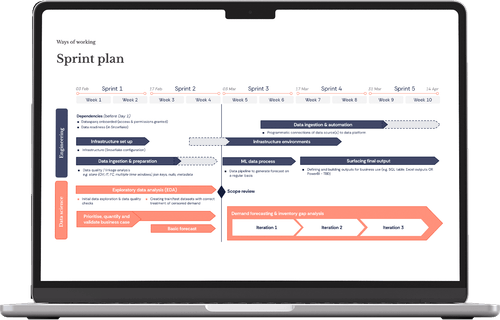
Extended to a more challenging network with multiple depots, handling unionised workforces, two-person deliveries and a wider variety of vehicle types. This phase demonstrated the optimiser's adaptability to different operational constraints.
Standardised data formats and pipelines to create a system applicable across diverse customer networks, with further optimisation for a home improvement retailer adding wait time and compactification features that doubled performance.
Explore how the science works in this PlayML data science notebook
The impact
The two-day workshop process delivered what traditional consulting approaches typically take months to achieve—a detailed, technically validated roadmap with signed-off ROI calculations. LBA received specific guidance on optimal staff allocation algorithms, real-time dashboard requirements and implementation timelines they could action immediately.
For customer operations, the staff allocation optimiser addresses the current manual, experience-based approach to daily task assignment. The solution reduces planning time whilst improving staff utilisation through optimal allocation algorithms. For security, the real-time visibility dashboard enables proactive queue management, with revenue benefits calculated from reduced passenger wait times leading to increased retail spending.
We worked closely with the finance team at LBA to provide accurate investment return projections. Benefits were modeled across conservative and optimistic scenarios to provide leadership with confidence ranges rather than single-point estimates. Rather than broad percentage improvements, we delivered specific pound-value benefits over defined timeframes—giving leadership the confidence to make informed investment decisions.
Beyond the immediate MVPs, the workshops established foundations for long-term AI transformation. Implementation roadmaps were designed with realistic constraints and dependencies in mind, while timing flexibility ensures pilots can avoid peak operational periods. The recommended phased approach (MVP → Pilot → Production) allows for thorough testing and user adoption before full deployment.
At its core, this project demonstrates that the best strategy work happens when technical expertise meets business insight in real-time—creating solutions that are both ambitious and executable.
Key impacts:
Ready to identify AI opportunities that deliver real value? Our rapid workshop approach gets you from challenge to executable roadmap in days, not months.