Do we still need consultants?



Intro
We’ve seen the headlines of large scale lay-offs; especially within the tech industry. Software engineers, developers and related roles tend to be a high proportion of those numbers. The rationale usually given for these mass firings is ‘AI efficiency’ or something to that effect. Essentially, if AI can do the job more cheaply, why hire a human? Full disclosure: I have vested interest in this subject as a Data Engineer in the tech sector. This is a question I have to contend with regularly. And up until now, I remain confident in the relevance of roles like mine and want to explain my confidence and why.
My argument is divided into the following areas: Skills, Productivity, Cost, Resource and Accountability.
Skills
Some historical context is necessary. After the ‘Industrial era’ (the Industrial Revolution in the 19th century), productivity was measured by physical output over time - very simple but effective. But eventually, with the advent of the internet, came the need for new metrics for online services, aka the ‘Internet/Digital era’. For instance, it became necessary to measure the value of physical encyclopedias sold in a store versus the value of its digital equivalent, Wikipedia (which effectively replaces them all). The point being, the advent of a substantially disruptive technology requires a whole new economic framework to adequately measure the economic impacts.
Researchers at MIT argue this point and propose that we have now collectively entered the ‘Intelligence era’[10], and that the tools we inherited from previous generations weren't designed to measure this.
This argument stems from the observation that Generative AI is adept at certain tasks, but not necessarily entire jobs. In many cases, AI can save a user time within a job. For instance, AI doesn’t replace a solicitor, but it can substantially reduce the amount of time they spend reviewing routine contracts. Another example being that a journalist will still write, but the time spent pulling quotes and research can quietly compress. The difference in this distinction is subtle but significant.
Productivity metrics have historically been measured by:
- GDP
- Unemployment levels
- Wage data
As measurements of wage, people and jobs, these metrics have been adequate historically, but they do not measure the tasks within jobs (as they were never designed to). Hence we end up in our current “iceberg” situation - where the real changes are hidden below the surface, and most people (including governments and policy makers) are looking elsewhere.
The Iceberg Index
Published by MIT in Dec 2025, the Iceberg Index is a framework for identifying the amount of exposure a job has to gen AI; therefore giving an indication of where and how susceptible a job is to being replaced by AI.
For its creation, the founders created digital representations of 151 million US workers across 923 occupations. The framework utilises official US jobs data from sources such as the O*NET dataset, which breaks down the tasks and skills required for a vast number of jobs to granular detail[10][11]. Using this data, MIT was able to create and execute the following methodology:
- Identify skills for each job
- Evaluate AI capabilities against each
- Aggregate skills into tasks, then into occupations
- Compute the Index values
- Convert exposure into economic value
- Map the exposure
Generative AI models were put through the same scoring process to get an apples-to-apples comparison. The end result is that we now have a more granular view of the exposure and risk current jobs have to replacement by gen AI models.
Using our own business, Datasparq, to illustrate, we see the following results:
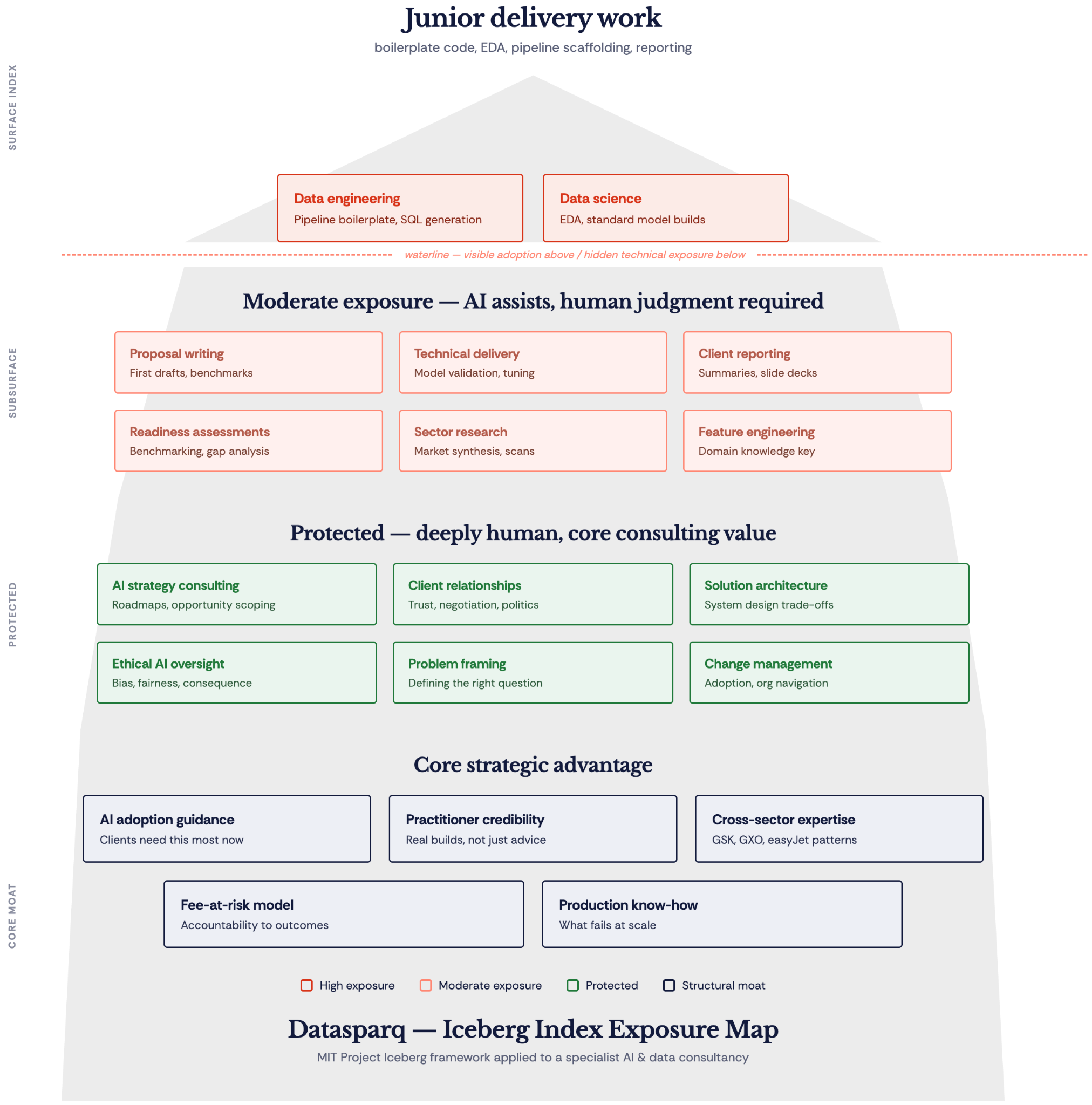
As you can see, although there is overlap in some surface level areas and tasks, the vast majority of what we at Datasparq offer clients in value, are not things which can be replicated by gen AI.
Productivity
There is a widespread assumption that the best way to achieve maximum efficiency is to automate the human out of a system. Outside of the empirical evidence highlighted in the Iceberg Index, there are an increasing number of reports across various industries of underwhelming gains due to gen AI reliance[14]. Furthermore, a growing number of companies are rehiring staff they initially let go under the banner of AI replacement. Klarna is the clearest example: its CEO admitted the company had gone too far in prioritising cost over service quality, and began rehiring customer support roles[14]. More broadly, one survey found that nearly a third of firms that cut roles citing AI later rehired for those same positions[1]. Separately, companies including Uber and Microsoft have pulled back on internal AI tooling after finding that usage at scale cost far more than expected, rather than delivering the savings promised[5][12]. Another trend emerging too: the companies who instead opted to give their employees access to appropriate AI tools and training, are seeing productivity gains and hence their profitability increase.[12][15]
Costs
Gen AI models, which initially began with free tiers for users, are actually heavily subsidised by the provider companies and their investors. As time goes on, many of these providers are increasingly turning to advertising to offset those costs — OpenAI launched ads in ChatGPT for free and low-cost tier users in the US in February 2026, with expansion to the UK and other markets confirmed in May 2026, though paid enterprise users remain exempt for now [16]. Additionally, subscriptions and token based charges are becoming the norm, particularly for premium experience and enterprise use. However even these versions of the model are actually subsidised. Furthermore the underlying unit economics of the subscriptions/tokens are often heavily guarded secrets. Tracking the Token Price Index (TPI)[13], the headline price of accessing the newest frontier models has been climbing, as each new flagship tends to launch at a premium. The cost per unit of capability has actually fallen over time, but for a business that always wants the latest and most capable model, the price of staying at the frontier has been rising, and the providers' ongoing push for profitability gives little reason to expect that to reverse.
The costs associated with corporate gen AI usage are significant enough that providers have built cost controls into the product itself. OpenAI's own product documentation confirms that once a user reaches their usage limit, requests can fall back to cheaper 'mini' models, including on paid subscription tiers [6]. Gizmodo separately reported that OpenAI now defaults free and lower-cost 'Go' users to its cheaper model, rather than automatically routing harder queries to a more capable one, as a deliberate cost-saving measure [9]. In essence, this means you could be relying on a less capable model than expected, without any clear notification.
Even the tech companies who once boasted about achieving AI efficiency such as Uber and Microsoft have changed tack after realising the cost of using generative AI at scale is actually more expensive than simply hiring a capable human being [1][5][7][12].
In the long run, businesses that rely heavily on generative AI for their operational output risk ceding significant leverage to their technology providers. This dependency could grant the suppliers a level of bargaining power comparable to that of a unionized workforce, potentially dictating terms to the organisation.
Resource
Data centres are an integral part of AI infrastructure, which require a substantial amount of resources to maintain. Current designs tend to require access to streams of fresh water for cooling and vast amounts of electricity. According to the International Energy Agency, data centres accounted for approximately 1.5% of global electricity in 2024, with consumption projected to roughly double to around 3% of global electricity by 2030 as AI demand continues to grow[3]. According to the IEA, individual AI-focused data centres can draw as much electricity as energy-intensive factories such as aluminium smelters[3]. Global data centre electricity demand is projected to roughly double by 2030, driven primarily by AI workloads[3]. (Earlier estimates suggested a single AI prompt used around ten times the energy of a traditional Google search, but the IEA's more recent analysis notes that energy use per query has fallen sharply as models become more efficient, so that figure is now out of date[3].)
Although not (currently) a direct cost to users, the increasing backlash and negative sentiment towards the building, supply chain dominance and existence of data centers around the world does not bode well for the likelihood of companies being able to meet the projected demand. This is already materialising: according to Bloomberg, citing market intelligence firm Sightline Climate, roughly a third to a half of planned US data centre capacity for 2026 is expected to be delayed or cancelled, driven largely by shortages of power infrastructure and electrical components[2]. Businesses would be wise to consider whether they can afford to put all of their trust in a technology which may not always be available.
Accountability
Last but not least is the fundamental (but often overlooked) question: if a professional is replaced by AI, who takes responsibility when things go wrong? For example in the physical world, when a taxi driver crashes a car, they take responsibility and are liable for the damages, obviously. But who takes responsibility when a driverless vehicle crashes? The driver (if there is one)? The passenger? The manufacturer? Elon?
Or if a doctor gives inaccurate medical advice, ultimately they will be held responsible.
But if a hospital utilises an AI model which gives inaccurate clinical advice in one instance, resulting in someone's poor health or worse, who is responsible for that advice? The patient? The hospital? Sam Altman?
There is no such thing as a flawless system. A problem can be accounted for in the design stage however, the world is imperfect, complex and always changing over time. A closed automated system can only look to the past for how to treat a new situation, and in doing so, make an error in decision making.
The concept of liability may be rudimentary and boring, but it is important as without it there is the risk of building powerful systems with no clear accountability for when things go wrong. Without accountability, the incentive to ensure things go right becomes diluted. In highly sensitive or regulated fields, is this void worth the risk?
Conclusion
As great as it is, generative AI can’t do everything, and attaches an ever increasing price tag to a project with little transparency at the centre. Heavy reliance on AI will likely result in making an organisation vulnerable to disruption, especially during peak periods.
AI can be a transformative tool and a skill multiplier. Best used as a tool for augmentation not replacement. To ensure smooth successful delivery of your product, there’s still no substitute for knowledgeable and experienced human professionals. Besides the reality that people are proving to be cheaper, they also provided essential accountability, reliability and flexibility in applications.
As the above shows, getting the right impact from AI is more nuanced than simply attempting wholesale replacement of human teams. It means understanding the right way to balance opportunity and risk. That subtlety is also something human judgement and experience is still invaluable for. The kind of experience we are living, day to day with our clients at Datasparq.
References
- Chakarian, Ella. “The 'AI boomerang': Why some companies are rehiring employees they laid off due to AI.” Fast Company, 5 June 2026, https://www.fastcompany.com/91554983/ai-boomerang-why-some-companies-are-rehiring-employees-they-laid-off. Accessed 19 June 2026.
- Wolfe, Steven. "Half of Planned US Data Center Builds Have Been Delayed or Canceled." Tom's Hardware, 3 April 2026, https://www.tomshardware.com/tech-industry/artificial-intelligence/half-of-planned-us-data-center-builds-have-been-delayed-or-canceled. Accessed 19 June 2026. (Citing Bloomberg/Sightline Climate data.)
- International Energy Agency. "Key Questions on Energy and AI." IEA, April 2026, https://www.iea.org/reports/key-questions-on-energy-and-ai. Accessed 19 June 2026.
- Green, Jemma. "AI Costs More Than The People It Replaced." Forbes, 2 July 2026, https://www.forbes.com/sites/jemmagreen/2026/07/02/ai-costs-more-than-the-people-it-replaced. Accessed 4 July 2026.
- Roth, Emma. "Microsoft reports are exposing AI's real cost problem: Using the tech is more expensive than paying human employees." Fortune, 22 May 2026, https://fortune.com/2026/05/22/microsoft-ai-cost-problem-tokens-agents. Accessed 19 June 2026..
- OpenAI. "Model Release Notes." OpenAI Help Centre, updated May 2026, https://help.openai.com/en/articles/9624314-model-release-notes. Accessed 19 June 2026.
- Interview Query. “Microsoft Is Hiring Again - But It Wont Be Business As Usual.” Interview Query, 27 March 2026, https://www.interviewquery.com/p/microsoft-hiring-ai-first-workforce-2025Accessed 19 June 2026.
- Khedkar, Omkar. “Beneath the Surface: What MIT’s Iceberg Index Reveals About AI’s Impact on the Workforce.” Medium, vol. -, no. -, 2025, -, https://medium.com/@khedkaromkars/beneath-the-surface-what-mits-iceberg-index-reveals-about-ai-s-impact-on-the-workforce-6c8504d3957a. Accessed Wed 17th June 2026.
- Dellinger, AJ. "OpenAI Defaults Free Users to Cheapest Model to Cut Back on Costs." Gizmodo, 16 December 2025, https://gizmodo.com/openai-defaults-free-users-to-cheapest-model-to-cut-back-on-costs-2000700346. Accessed 19 June 2026.
- Malamut, Melissa, and Massachusetts Institute of Technology. “The Iceberg Index: Measuring Skills-centered Exposure in the AI Economy.” Project Iceberg, 8 July 2025, https://iceberg.mit.edu/report.pdf. Accessed 17 June 2026.
- M.I.T. University. “Project Iceberg.” Project Iceberg - Coordinating the Human-AI Future, Dec 2025, https://iceberg.mit.edu/. Accessed 17 June 2026.
- Morana, Azia. “Microsoft And Uber AI Bills Mount: Workers Urged To Stop Using Claude As Costs Bite.” IB Times, 24 May 2026, https://www.ibtimes.co.uk/tech-giants-rethink-ai-adoption-rising-costs-1798618. Accessed 19 June 2026.
- Token Price Index. “Token Price Index.” AI Token Price Index, https://tokenpriceindex.com/. Accessed 18 June 2026.
- IBTimes UK. "The Great AI Layoff Didn't Go As Planned: Employers Are Rehiring Staff." International Business Times, July 2026, https://www.ibtimes.co.uk/ai-layoffs-backfire-companies-rehire-1806668. Accessed 4 July 2026. (Citing Gartner research on enterprise AI adoption.)
- Markman, Jon. "Why Today's AI-Driven Layoffs Are Becoming Tomorrow's Rehiring Crisis." Forbes, 4 March 2026, https://www.forbes.com/sites/jonmarkman/2026/03/04/why-todays-ai-driven-layoffs-are-becoming-tomorrows-rehiring-crisis. Accessed 19 June 2026.
- OpenAI. "Testing ads in ChatGPT." OpenAI, 16 January 2026, https://openai.com/index/testing-ads-in-chatgpt. Accessed 19 June 2026. (Expansion to UK, Mexico, Brazil, Japan and South Korea confirmed 7 May 2026.)
Learn more →